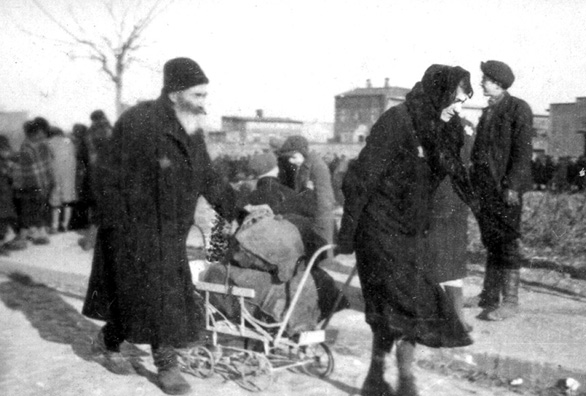
The Food Supplies Department (Bałucki Market), established in May 1940, was in charge of obtaining supplies for the ghetto. The main tasks included obtaining and distribution of food, fuel and medicines received from the German authorities. It was carried out by means of rationing goods. Organizationally, it was divided into seven departments: Kitchens, Colonial Goods and Bread, Tobacco, Vegetable, Coal, Meat, and Food Coupons. The Department tried to fight omnipresent hunger. 462 cheap house kitchens were set up, and then, in January 1941, further 73 municipal and departmental kitchens were opened.
Food supplies in the ghetto depended on the Germans from the very beginning, and almost never reached the level designated by them. Smuggling, which in other ghettos improved the supply, was virtually impossible given how tightly the Łódź ghetto was sealed off. The ghetto residents not only received food in insufficient quantity, but also often it not suitable to eat at all (e.g. waste from the Green Market).
One of the chroniclers of the ghetto, Oskar Singer, describes the food situation in the ghetto in a report written after a visit to the Department of Dairy Products, where different kinds of food waste were used to prepare the so-called salad: “In the yard we are hit by an odd smell, or rather - to be honest - stench. We do not know where it is coming from. Hand carts that we recognize have just brought vegetables. Vegetables! Wilted leaves of red beet and kale. (...) Several women are sorting this miserable waste. They are withered, but that is not a problem. Only rotten ones are thrown out. The rest is washed carefully in barrels. Water is painstakingly carried from the well. Dust, dirt and mud fall off, three-times soaked leaves are revived, they look fresh again. (...) “But what's that awful stench?” we have to ask. Grinning widely, the vegetable artists indicate a muddy surface, looking very much like sludge. “These are our potatoes”. Words failed us. This horrible stinking muck is supposed to go into the salad? But these are, after all, potatoes, such as were delivered to the ghetto, the so-called second sort. (...) Every woman is searching a pile of that muck for harder pieces, carefully peeling the "healthy core" out of its stinking shell, which has been drying in the sun in the sludge for days. But even those healthy pieces still stink. They have yet to be soaked.”
Oskar Singer
General weakness caused by hunger was the reason for a high incidence of various diseases among the residents of the closed district.
"A man deprived of soup ceases to exist. Dr. Fels is lying alone with his legs swollen on a cot in his >> apartment <<, waiting for death. As an >> unemployed << person, he is not entitled to an extra ration of soup.
He asks everyone who visits him to write and submit an application with a request for the life-giving soup. Dr. Fels knows that such meal could save him. He is unable to write such an application himself. In the end, he dies of starvation like the most wretched pauper.”
Oskar Singer
“When it comes to smuggling, I must emphasize that in this respect the Łódź ghetto was not like other ghettos. It was designed in such a way that any contact with the outside was impossible. The Germans created a neutral zone between the ghetto and the rest of the city. It was enough to go to Nowomiejska Street where houses from number 15 up to Łódzka Street, particularly large brick houses, were completely demolished. So, there was a neutral zone around the ghetto, illuminated with headlights at night and surrounded by guards.”
Leon Szykier